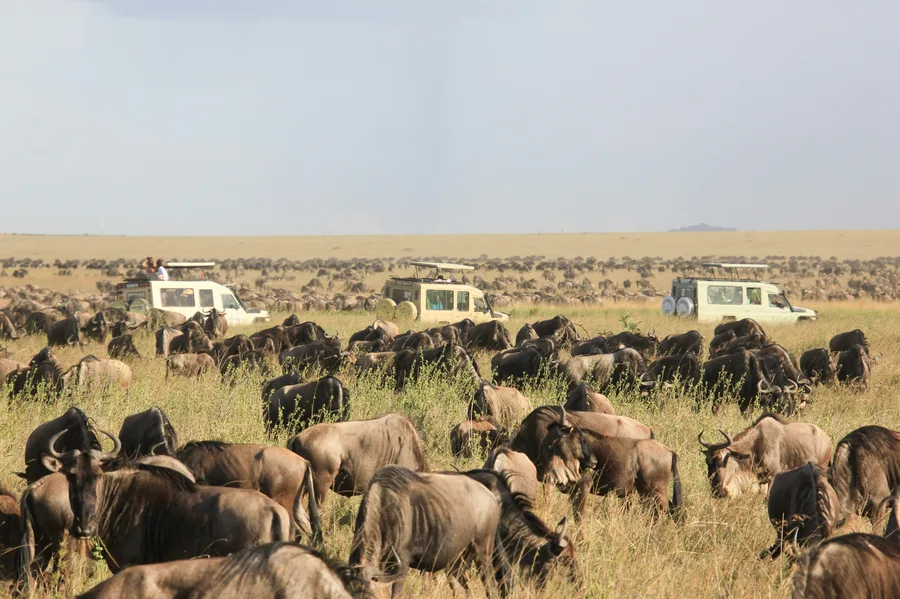
Every wildlife documentary shows you the same thirty seconds: wildebeest at the riverbank, a pause, a surge, chaos, a crocodile. What those thirty seconds don't show you is the six hours that usually come before them — or how much of the experience is actually about waiting, not watching.
The Great Migration isn't a single event. It's a year-round movement of roughly two million wildebeest, zebra, and gazelle, circling the Serengeti-Mara ecosystem in search of fresh grazing. The river crossings — the part everyone comes for — are really just the most dramatic chapter in a story that never actually stops.
The waiting is the point
On our first morning at the Mara River, we watched a herd of several hundred wildebeest gather at the bank for nearly three hours without a single one entering the water. They'd approach, hesitate, retreat, regroup. A ranger explained that this hesitation is instinctive — the animals at the front are, in a very real sense, deciding whether they're the ones who die today.
"You start to understand that what looks like chaos from a distance is actually one of the most calculated risk assessments in nature."
When the crossing finally happens, it happens fast — the entire herd can be in and across within ten to fifteen minutes. Crocodiles take some. The current takes others. Most make it. Then the plains go quiet again, and the waiting starts over half a mile downstream.
What nobody tells you about the sound
Documentaries mute or score over most of what a crossing actually sounds like — a constant, guttural grunting from thousands of animals at once, punctuated by splashing and, if you're close enough, the distinct sound of a current pulling something under. It's not something you forget.
Timing it right
If a river crossing specifically is what you're after, June through September is when the migration is typically moving through the northern Serengeti and crossing into the Masai Mara — though "typically" is doing some work in that sentence. The animals don't read the guidebooks. Camps with good local guides track movement daily and can often get you close, but no operator can promise you'll see a crossing on any given day.
We've written a full breakdown of when to go and what to expect on the Serengeti destination page, including the calving season alternative if crossings aren't the priority.



Thinking about planning your own safari? The GoAtlas team can help time it around the migration's actual movement, not just the calendar.
Speak with the GoAtlas Team